
The Comfort of Predictability
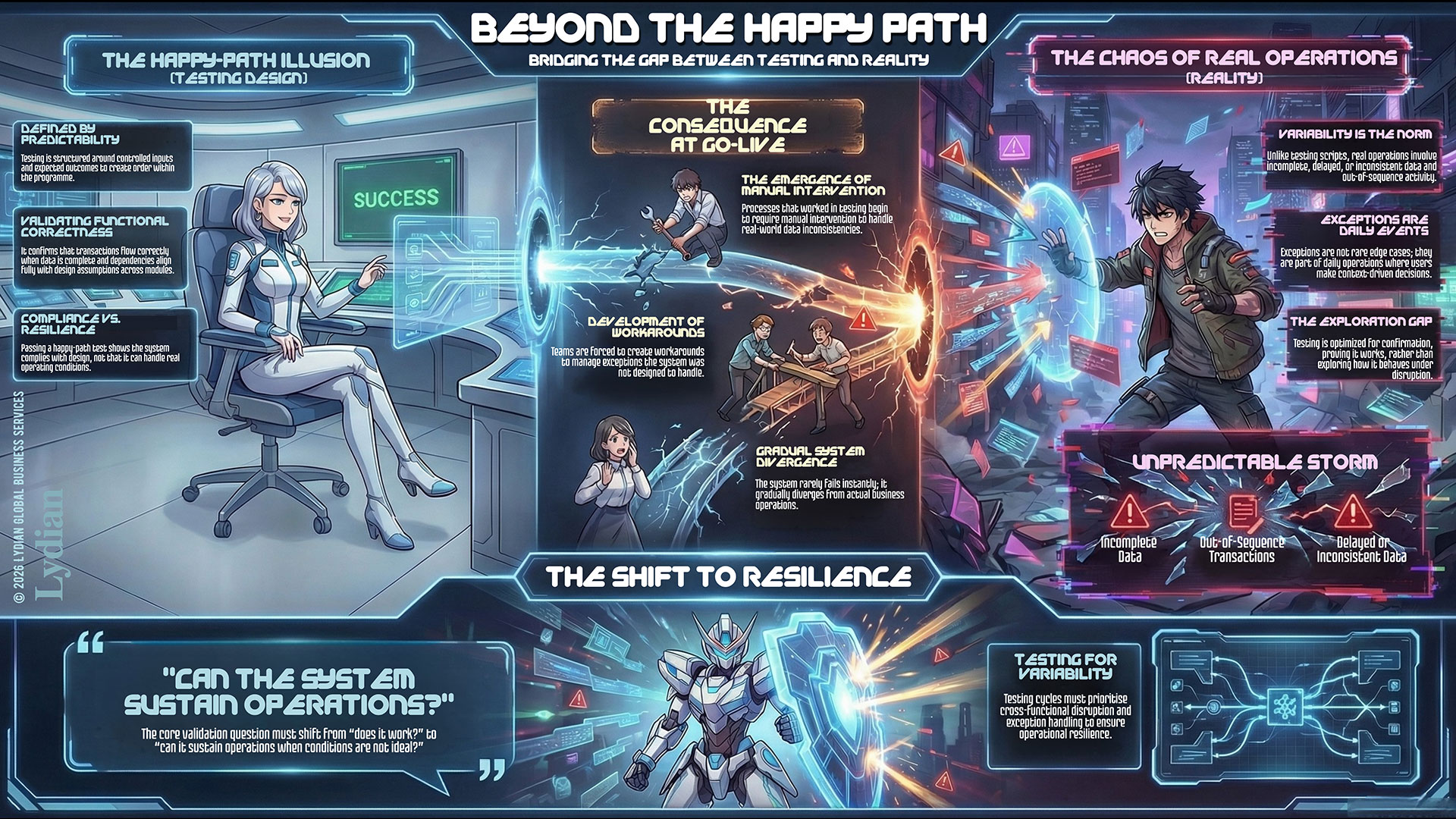
In most SAP programmes, testing is designed around predictability. Scenarios are defined, inputs are controlled, and expected outcomes are clearly documented. These “happy-path” tests confirm that processes work when conditions align with design assumptions. From a programme perspective, this creates order. It ensures that the system behaves as intended under ideal conditions and provides a structured basis for validation.
What Happy-Path Testing Actually Validates
Happy-path testing validates that the system can execute predefined processes without deviation. Transactions flow correctly when data is complete, timing is aligned, and dependencies behave as expected. Each module demonstrates functional correctness within its scope, and integration points confirm that systems communicate as designed. The outcome is a system that performs reliably under controlled, expected conditions.
Where Real Operations Differ
Real operations rarely follow ideal paths. Data is incomplete, delayed, or inconsistent. Transactions occur out of sequence. Dependencies do not align perfectly across functions. Exceptions are not rare events; they are part of daily operations. Users make decisions based on context, not predefined scripts. The operating environment introduces variability that cannot be fully captured in structured testing scenarios.
The Gap Between Design and Reality
The gap emerges because testing is optimised for confirmation, not exploration. It proves that the system works when conditions are correct, but it does not sufficiently challenge how the system behaves when conditions are not. Edge cases, exception handling, and cross-functional disruptions are often underrepresented in testing cycles, even though they define real business behaviour.
The Consequence at Go-Live
When the system encounters real operations, the difference becomes visible. Processes that worked in testing begin to require manual intervention. Data inconsistencies create unexpected outcomes. Teams develop workarounds to manage exceptions that were never validated. The system does not fail in a single moment. It gradually diverges from the way the business needs to operate.
The Question Before Validation
The relevant question is not whether the system works under ideal conditions. It is whether the system can sustain operations when those conditions are no longer ideal. This requires testing that reflects variability, not just correctness.
A system that passes the happy path has demonstrated compliance.
It has not yet demonstrated resilience.