
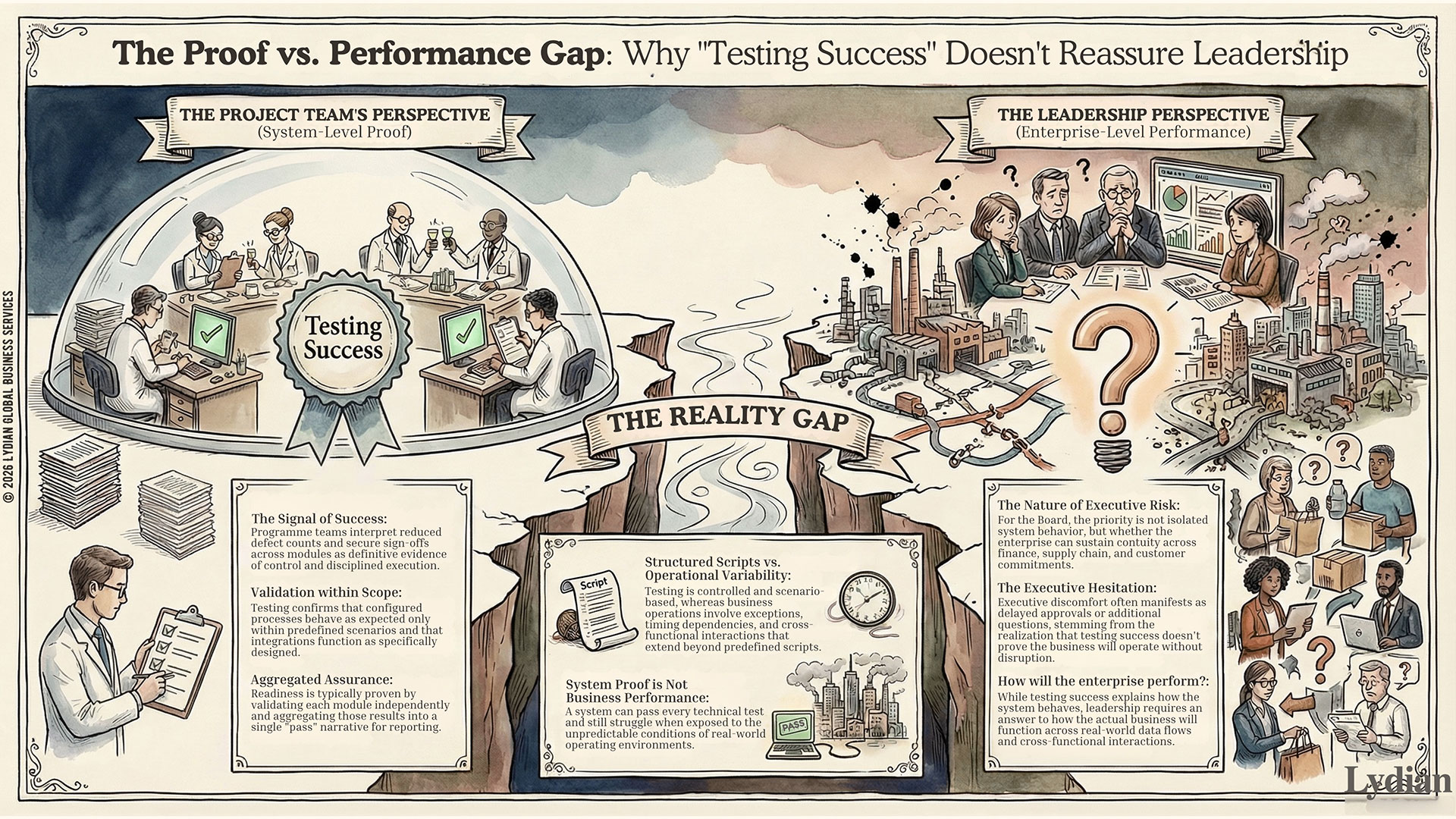
The Signal of Success
In most SAP programmes, testing success is presented as a definitive milestone. Cycles are completed, defect counts are reduced, and sign-offs are secured across modules. Programme teams interpret this as evidence of control and disciplined execution. For reporting purposes, the narrative is clean. The system has been tested, and it has passed.
What Testing Success Actually Confirms
Testing success confirms that configured processes behave as expected within predefined scenarios. It validates that integrations function as designed and that known defects are either resolved or accepted within tolerance. Each module proves its readiness independently, and these validations are aggregated into a programme-level assurance. The system works within the scope it was asked to prove.
Why Leadership Remains Uncertain
Despite this, leadership often hesitates. The discomfort is not always expressed in technical terms, but it appears in additional questions, delayed approvals, and a reluctance to fully endorse go-live readiness. This is not a failure of communication. It is an instinctive recognition that testing success does not fully answer the question leadership is accountable for, which is whether the business will continue to operate without disruption.
The Gap Between Proof and Performance
The distinction lies between proving that the system works and proving that the enterprise will function on it. Testing is structured, controlled, and scenario-based. Business operations are not. They involve variability, exceptions, timing dependencies, and cross-functional interactions that extend beyond predefined scripts. A system can pass every test and still struggle when exposed to real operating conditions.
The Nature of Executive Risk
For the CEO and the Board, the risk is not whether the system behaves correctly in isolation. It is whether the enterprise can sustain continuity across operations, finance, supply chain, and customer commitments. Testing success provides confidence at the system level. Leadership decisions require confidence at the enterprise level.
The Question Behind the Discomfort
Leadership hesitation is often the correct question forming without a structured answer. It is not whether testing has been completed. It is whether the system has been validated against how the business actually operates across functions, data flows, and real scenarios.
Testing success explains how the system behaves.
Leadership needs to know how the enterprise will perform.